
Universities, colleges, certification bodies and online learning providers now run a lot of their exams online: semester exams, entrance tests, professional certifications and remote evaluations.
For the exam office, the hard part often starts after the exam ends. A student appeals a result. Someone wants to know whether the right person sat the paper. A reviewer has to explain what happened halfway through a session. You can only answer those questions if you captured the right information while the exam was running.
That’s the job of an online assessment platform. Proctorly by TatvaOne.AI brings exam delivery, identity verification, AI monitoring, human review and evidence management together, so everything about a candidate’s exam sits in one record you can actually use.
What is an online assessment platform?
An online assessment platform is software that lets institutions create, deliver, monitor and manage exams remotely. A complete platform covers the whole exam process: building and delivering the paper, verifying candidates, monitoring the session, sending flags to a human reviewer, and keeping the records needed for audits and appeals.
A quiz tool stops once the questions are delivered. A full assessment platform keeps going and covers:
- online exam creation and delivery
- candidate identity verification
- AI-powered exam monitoring
- human review of flagged incidents
- exam records and audit trails
- evidence management for appeals
On a high-stakes exam, you need all six. Leave one out and there’s a gap in the record, and appeals have a way of finding gaps.
Key takeaways
- An online assessment platform lets you create, deliver, monitor and manage exams remotely, and it keeps the evidence behind each result.
- For high-stakes exams, delivery isn’t enough. You also need identity checks, AI monitoring, human review and an audit trail.
- On Proctorly, AI flags potential problems, trained reviewers look at them, and your institution makes the final call.
5 features every secure online assessment platform needs
1. Online exam software that handles real exam formats
Exams come in all shapes, so your software has to handle more than multiple choice. Proctorly supports multiple-choice, true or false, numeric, short answer, essay, matching and file upload questions. You can add section timers, use adaptive testing and randomize question delivery, so each paper fits the subject it’s testing.
2. Identity verification at the start and throughout the exam
When nobody’s in the room with the candidate, the first question is simple: is this the person who registered? Proctorly runs face verification when the exam starts, then keeps checking throughout. If the exam calls for it, you can also switch on photo ID capture and active liveness challenges.
And if an identity check fails? The candidate isn’t failed automatically. The case goes to a person to review first.
3. AI monitoring built for today’s exam threats
These are the known exam threats Proctorly watches for:
- unauthorized AI tools
- second devices
- remote-access software
- screen recording
- additional monitors
- virtual machines
- suspicious browser extensions
When it spots one, it raises a flag so someone can review the activity.
4. Human review of flagged incidents
A flag means “take a look”, and that’s all it means. AI monitoring on its own shouldn’t decide whether a candidate broke the rules.
When a reviewer opens a flag in Proctorly, the webcam footage, the screen activity and the recorded events sit side by side on one timeline, so they can piece together what happened. They can’t save a decision without giving a reason.
That cuts down on alerts being mistaken for misconduct, and your institution sees the full picture before it decides anything. We’ve written more about why every AI flag needs a human.
5. Evidence and an audit trail that hold up
Sooner or later, someone will challenge a result, or an auditor will ask how a decision was made. A score on its own won’t help you then. Proctorly opens a case record for each candidate and keeps a tamper-evident audit trail of views, decisions and changes. When you need it, you can generate an evidence pack for an exam review, an appeal or an audit.
Why do universities need more than basic online exam tools?
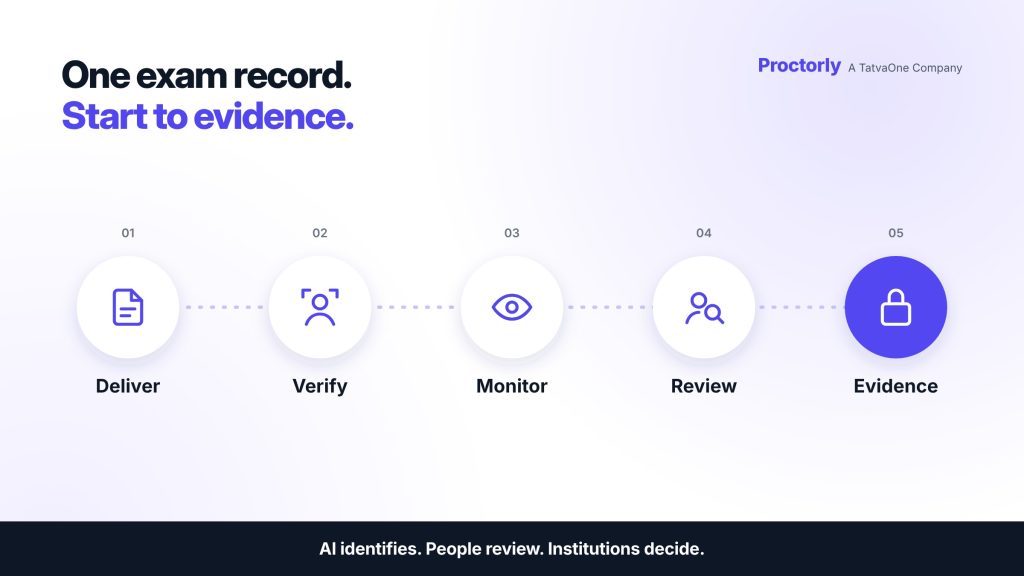
A basic online exam tool is fine for practice quizzes, classroom activities and low-stakes tests. Entrance exams, end-semester assessments and professional certifications are different. Once they’re over, the university has to be able to answer five questions:
If identity checks, monitoring and review live in separate tools, you’ll be hunting for those answers in three places. An online assessment platform keeps all five in one exam record.
How Proctorly matches the assurance level to the exam
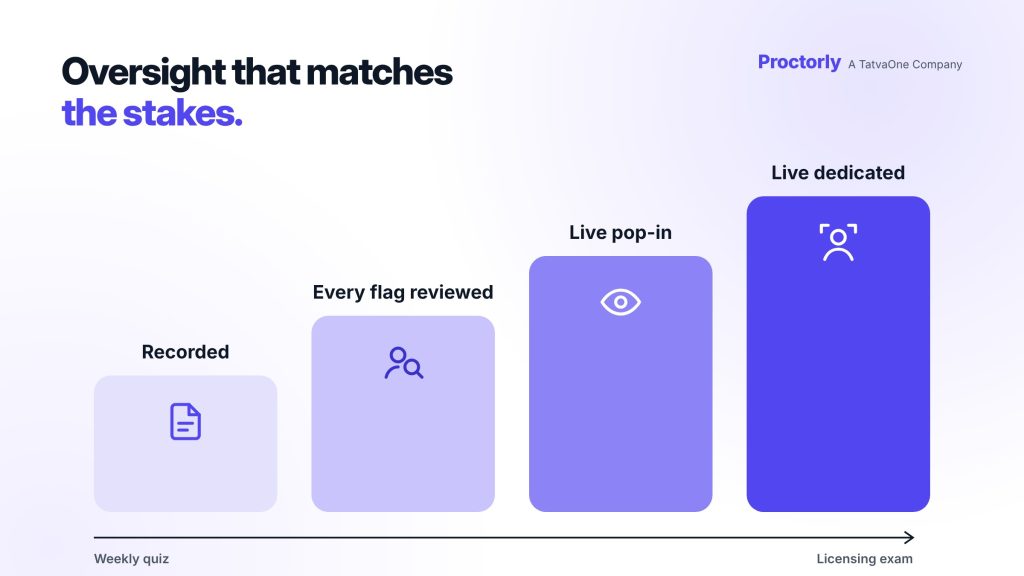
A weekly quiz doesn’t need the same oversight as a licensing exam, so you choose a monitoring option for each exam. There are four:
| Assurance level | What happens |
|---|---|
| Recorded | Identity checks, session recording and automated flags, which go to the institution for review. |
| Every flag reviewed | A Proctorly reviewer examines every automated flag before the case reaches the institution. |
| Live pop-in | A live proctor can step in through chat or audio when a monitoring signal is triggered. |
| Live dedicated | A proctor monitors a small group of candidates for the whole exam. |
Both live options come through Proctorly’s proctoring service, with trained proctors. Not sure which level fits? Our comparison of AI proctoring, live proctoring and record and review walks through the trade-offs.
Who can benefit from Proctorly?
You’ll find Proctorly in a few kinds of organizations:
- Universities and colleges run internal assessments, semester exams and high-stakes online exams.
- Admissions teams run remote entrance exams and screen applicants across multiple locations.
- Certification and licensing bodies deliver secure remote certification and licensing exams.
- Online and distance learning providers assess students who take their exams remotely.
What makes Proctorly different?
Delivery, identity verification, AI monitoring, human review and evidence management all live in one platform. The bigger difference is how the work is divided. The AI looks for potential exam threats, trained reviewers examine whatever it flags, and your institution always has the final say.
You also don’t have to replace the systems you use today. Proctorly supports Moodle integration through OAuth and LTI 1.3, the interoperability standard published by 1EdTech, and it supports Canvas, Blackboard and other learning platforms too. You can start with the core exam platform and add exam management capabilities later, when you need them.
Frequently asked questions
It’s software that lets you create, deliver, monitor and manage exams remotely. A full platform also verifies candidates, sends flagged activity to a human reviewer, and keeps the records and evidence you’ll need for audits and appeals.
It watches the exam session for known threats, such as unauthorized AI tools, second devices, remote-access software and virtual machines, and flags anything it detects. On Proctorly, a reviewer then checks the webcam footage, screen activity and recorded events together on one timeline.
Not on Proctorly. Flags and failed identity checks go to a person for review, every saved decision needs a reason, and the final decision stays with your institution.
It checks the candidate’s face at the start of the exam and keeps checking throughout. Depending on the exam, you can also turn on photo ID capture and active liveness challenges.
Multiple-choice, true or false, numeric, short answer, essay, matching and file upload questions. You can also use section timers, adaptive testing and randomized question delivery.
Yes. Proctorly integrates with Moodle through OAuth and LTI 1.3, and it also supports Canvas, Blackboard and other learning platforms.
Each candidate gets a case record, and Proctorly keeps a tamper-evident audit trail of views, decisions and changes. You can generate evidence packs for exam reviews, appeals and audits.
Conclusion: build trust in every online exam
People trust an online exam when you can explain what happened in it. That means knowing who sat it, monitoring it in a way candidates understand, having a person review what gets flagged, and keeping evidence that backs up the result. An online assessment platform is where all of that comes together.
With Proctorly, universities, colleges and certification bodies can run secure online exams and keep people in charge of the decisions that matter. Or, as we like to put it: AI identifies. People review. Institutions decide.
Ready to make your online exams more secure?
Want to see how this would work for your exams? Book a demo and we’ll walk you through it.