
Key takeaways
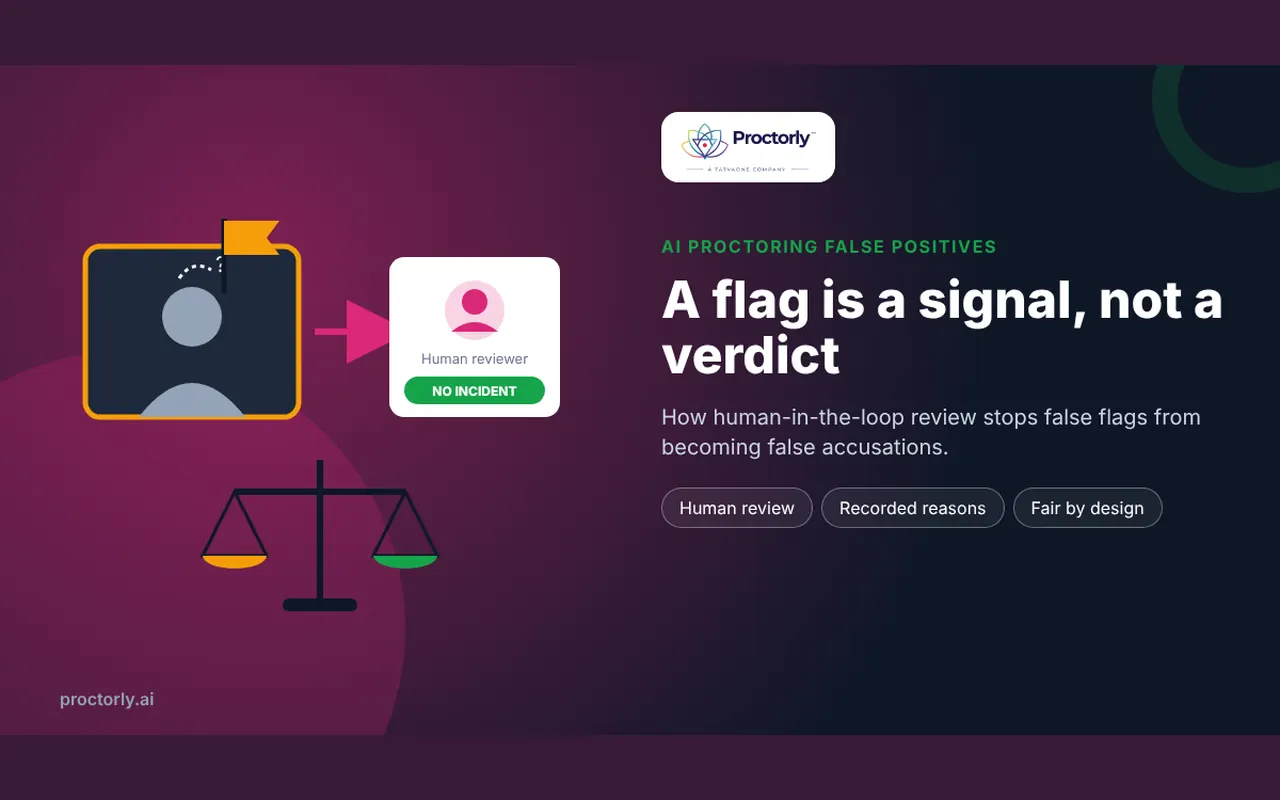
- A false positive is an AI flag on behaviour that was not misconduct: looking away to think, a family member walking past, a webcam dropping frames.
- False positives are unavoidable in any detection system. The harm comes when a flag is treated as a verdict.
- The fix is design: human review of every flag, recorded reasons, nudges before flags, fairness testing and clear appeals.
- Track the gap between flags raised and incidents confirmed. A big gap means your settings need work.
- Regulators are moving the same way. The EU AI Act treats exam-monitoring AI as high-risk.
Ask students what worries them about online proctoring and you will rarely hear ‘getting caught’. You will hear ‘being accused of something I did not do’. Stories of students flagged for looking at the ceiling while thinking, or for a sibling walking into the room, spread quickly and damage trust in an entire exam programme.
Those stories are not an argument against AI monitoring. They are an argument against letting software make decisions.
Want to see how Proctorly handles flags before they reach a student? Book a meeting.
What is a false positive in AI proctoring?
A false positive in AI proctoring is an automated flag raised on behaviour that was not misconduct. It happens because AI detects patterns such as gaze direction, a second face or background noise, but cannot understand context. False positives become harmful only when a flag is treated as proof without human review.
Why AI proctoring flags innocent candidates
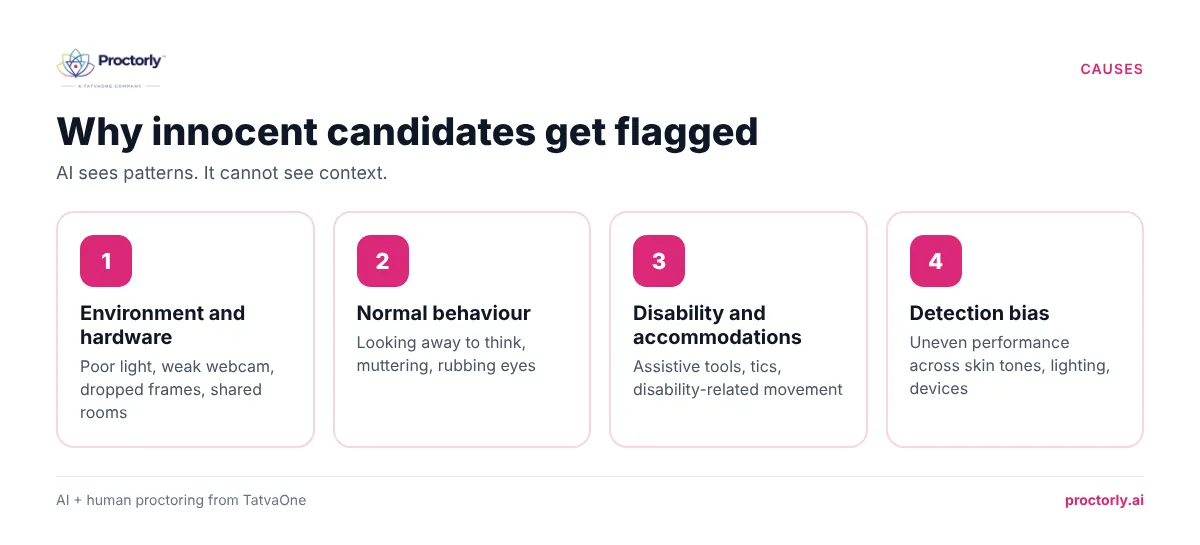
Environment and hardware
Poor lighting, a low-quality webcam, a weak connection or a shared room can all trigger flags. A frozen frame can look like a face leaving the camera.
Normal human behaviour
People look away when they think. They mutter while working through a problem. They rub their eyes. None of this is cheating.
Disability and accommodations
Screen readers, assistive tools, tics or movement linked to a disability can look unusual to a model trained on ‘typical’ behaviour.
Bias in detection
Face detection and verification can perform differently across skin tones, lighting conditions and devices. That makes fairness testing essential, not optional.
What false positives cost you
- Staff time: every flag someone has to review or argue about.
- Appeals and complaints: each one takes committee time and can escalate.
- Student trust: once students believe the system is unfair, they question every result.
- Reputation and regulation: a public case of a wrongly accused student can follow an institution for years.
The EU AI Act classifies AI used to monitor and detect prohibited behaviour of students during tests as high-risk, noting such systems can shape a person’s educational and professional path (EU AI Act Annex III; Recital 56). Human oversight is central to the obligations that follow.
See Proctorly’s flag review in a live exam. Book a Proctorly demo.
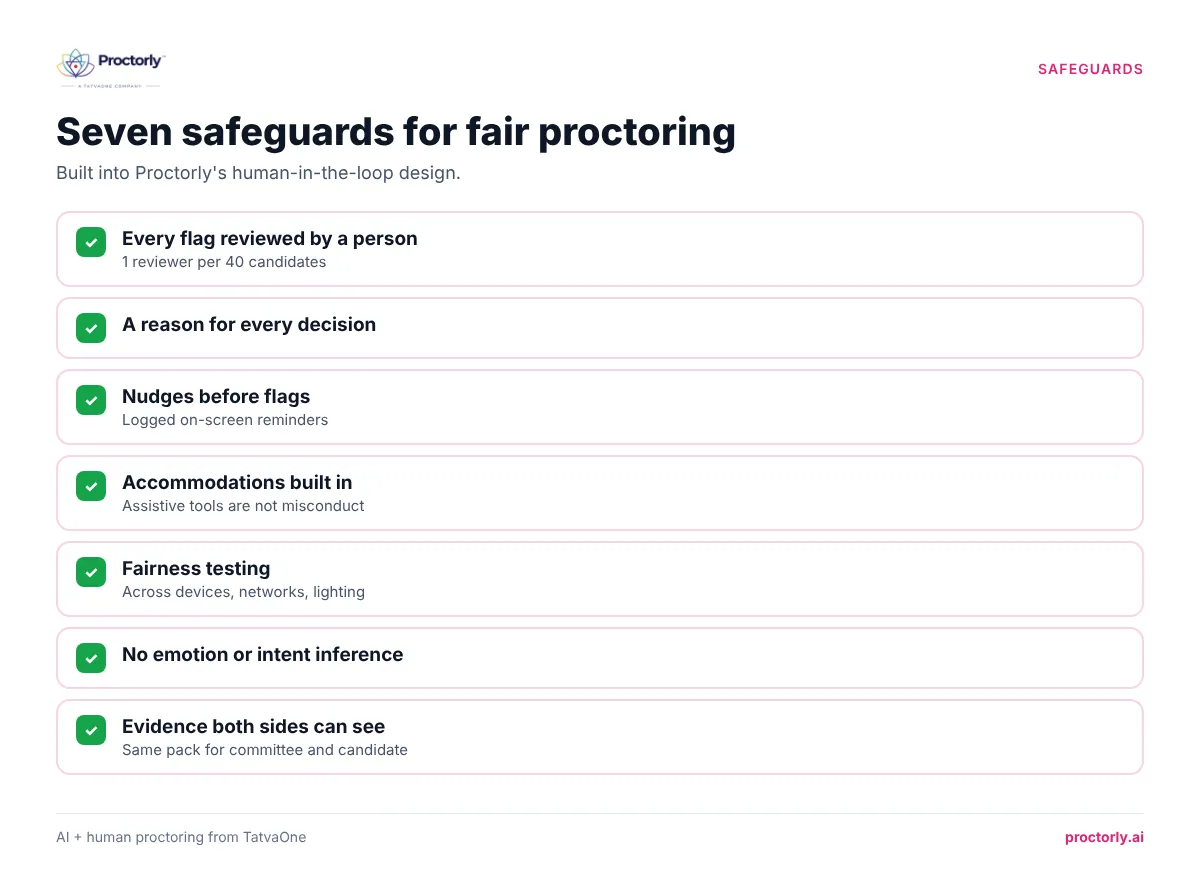
Seven safeguards that keep flags fair
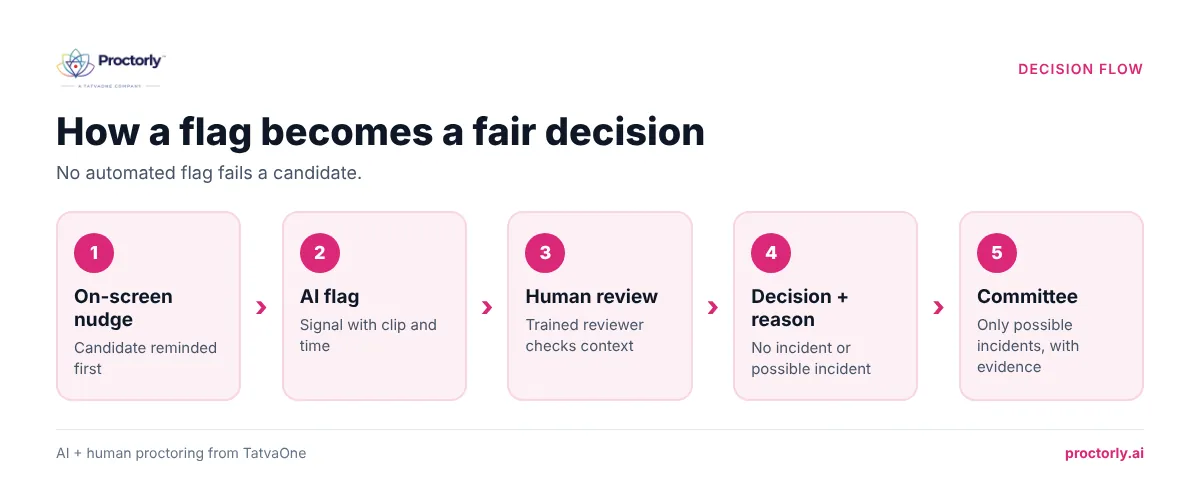
- Every flag reviewed by a person. In Proctorly, trained reviewers check each flag at one reviewer per 40 candidates. No automated flag can fail a candidate or impose a sanction. See how review works.
- A reason for every decision. Reviewers record ‘no incident’ or ‘possible incident to escalate’, always with a reason.
- Nudges before flags. Logged on-screen reminders give candidates a chance to correct course (for example, returning to camera) before anything is flagged.
- Accommodations built in. Reading aloud, assistive tools and disability-related movement are not treated as misconduct. See the accessibility page.
- Fairness testing. Detection is checked across devices, networks, lighting and accommodations.
- No emotion or intent inference. Proctorly does not infer emotion, personality or intent from faces or voices. Read the responsible AI principles.
- Evidence both sides can see. The evidence pack gives the committee and the candidate the same clips, timeline and reasons during an appeal.
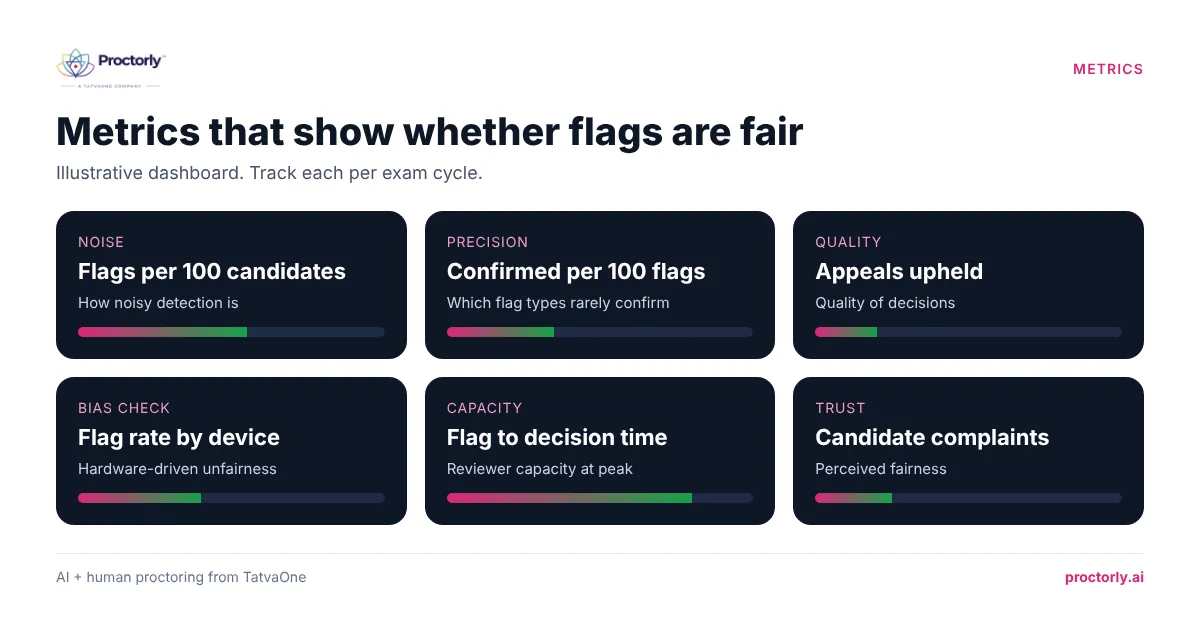
Metrics to monitor fairness
| Metric | What it tells you | Action if it moves the wrong way |
|---|---|---|
| Flags per 100 candidates | How noisy detection is | Tune settings, add nudges, improve candidate guidance |
| Confirmed incidents per 100 flags | Precision of flags after review | Investigate which flag types rarely confirm |
| Appeals upheld | Quality of decisions | Retrain reviewers, review decision guidance |
| Flag rate by device or connection type | Hardware-driven bias | Adjust thresholds, offer device guidance |
| Time from flag to decision | Review capacity | Add reviewers for peak windows |
People also ask
Can AI proctoring wrongly accuse students? AI can flag innocent behaviour. Whether that becomes an accusation depends on whether a person reviews the flag before any action.
Does looking away get you flagged in a proctored exam? It can, in some systems. In a human-reviewed system, a reviewer would see the context and close the flag.
Is AI proctoring biased? Detection can perform unevenly across conditions. Fairness testing and human review reduce the impact.
FAQs
What happens to a flag in Proctorly?
A trained reviewer checks it, usually within minutes (95 of every 100 within 5 minutes), and records a decision with a reason. Only possible incidents go to your committee.
Can students see the evidence if they appeal?
Your institution sets the appeal process. The evidence pack gives the committee and the candidate the same facts.
Does Proctorly claim to catch all cheating?
No. Proctorly publishes its coverage limits. Honest limits help institutions design exams sensibly.
How can we reduce false positives before exam day?
Clear candidate guidance, a system check, sensible per-exam settings and on-screen nudges. Book a meeting to review your settings.
Fair by design
Every detection system produces false positives. The institutions that keep student trust are the ones that never let a flag become a finding without a person, a reason and evidence. That is how Proctorly is built. Read more in our guide to what proctoring can detect.
Run fairer online exams. Book a Demo or Book a Meeting.