

Key takeaways
- Proctored assessments in corporate training verify that the employee who earned a certificate or passed a compliance test actually did the work.
- They matter most where a result carries risk: regulatory compliance, safety, licensed activity, partner certification and customer-facing credentials.
- Most training quizzes do not need proctoring. Reserve it for assessments that unlock access, authority or a credential.
- Transparency with employees and works councils matters as much as the technology.
- In the EU, AI that monitors behaviour during tests in vocational training is classed as high-risk, so human oversight is essential.
Completion rates look great on an L&D dashboard. Auditors and regulators are less impressed. When something goes wrong, the question is rarely ‘did they complete the module?’ It is ‘can you prove this person knew the procedure?’
That is where proctored assessments come in. Used selectively, they turn a completion record into evidence of competence.
Running compliance or certification assessments online? Book a meeting to see where proctoring fits your program.
What are proctored assessments in corporate training?
Proctored assessments in corporate training are online tests for employees, partners or customers that run under supervision. The learner’s identity is verified, the test runs in a controlled browser, and activity is monitored and reviewed, so the organization can show that the certified person passed the assessment on their own.
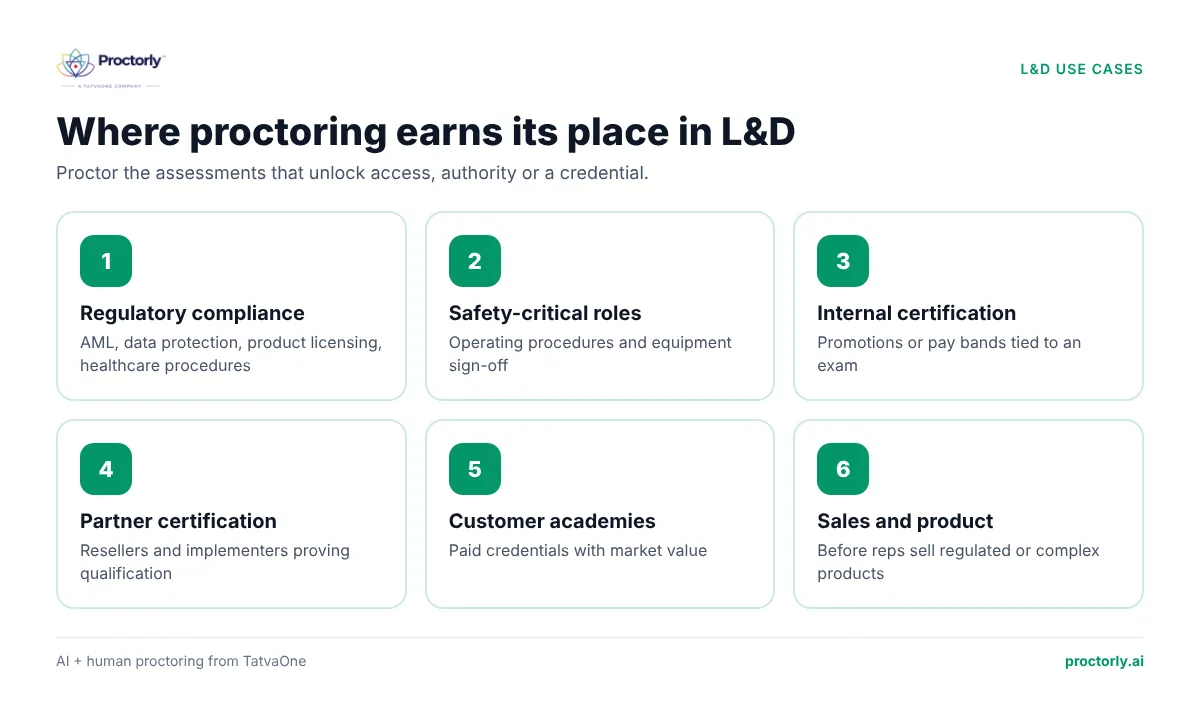
Where proctoring earns its place in L&D
- Regulatory and compliance certification: anti-money-laundering, data protection, financial product licensing, healthcare procedures.
- Safety-critical roles: operating procedures, equipment sign-off, quality standards.
- Internal certification ladders: promotions or pay bands tied to passing an exam.
- Partner and reseller certification: proving that partners selling or implementing your product are qualified.
- Customer academies and paid credentials: where the certificate itself has market value, much like vendor IT certifications.
- Sales and product certification: before reps can sell regulated or complex products.
A stakes-based framework for training assessments
| Assessment | Consequence of a fake pass | Suggested control |
|---|---|---|
| Knowledge checks inside modules | Low | None or randomized questions |
| Annual compliance attestation | Medium | Face verification, recorded review |
| Role or promotion certification | High | ID, continuous face match, every flag reviewed |
| Licensed or safety-critical sign-off | Very high | Live check-in and live proctoring, evidence pack |
| Paid external credential | Very high | Live dedicated proctoring, published candidate rules |
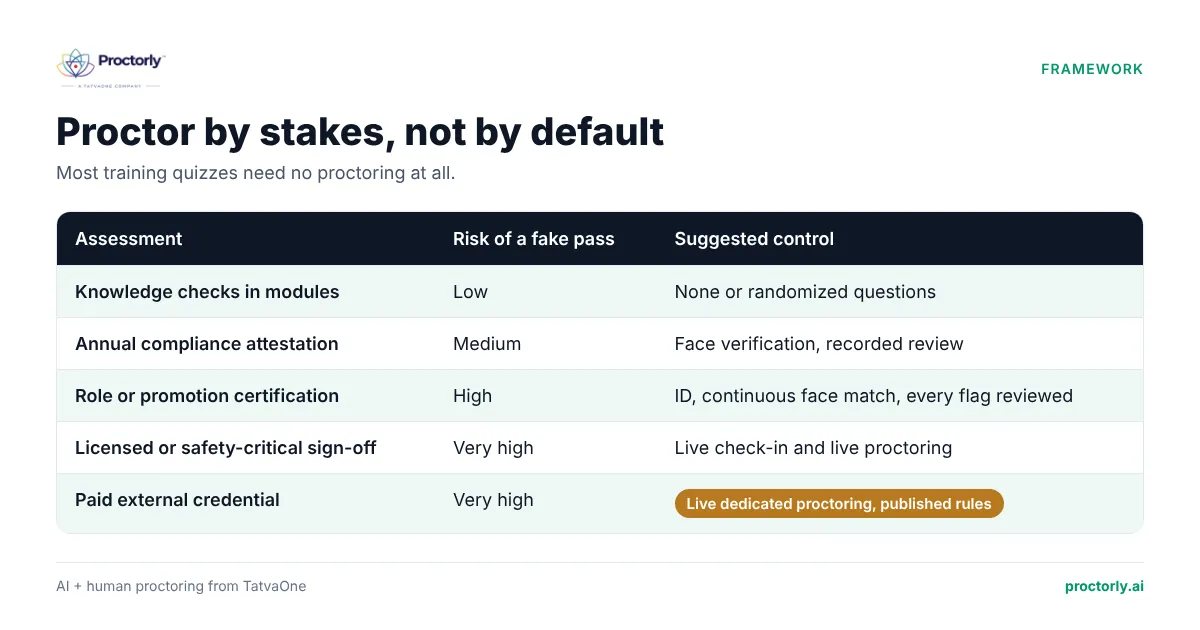
Proctorly lets you set this per exam, so one platform can run a light attestation and a strict certification side by side. See how the four assurance levels compare.
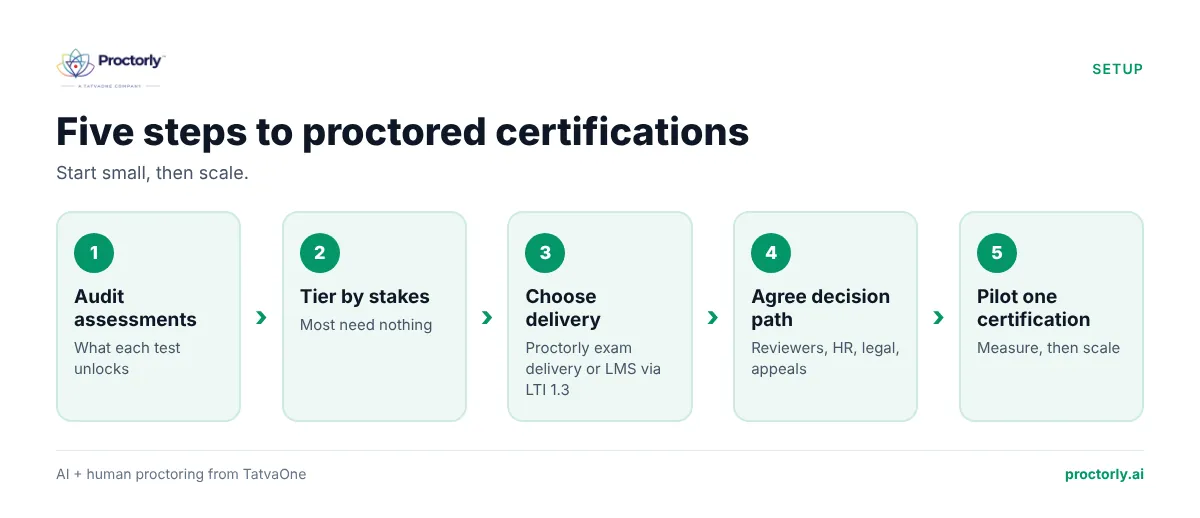
How to add proctoring to your training program in 5 steps
- Audit your assessments. List every test, who takes it and what passing unlocks.
- Tier them by stakes using the framework above. Most will need nothing.
- Choose delivery. Run proctored exams in Proctorly’s exam delivery environment or connect through your LMS via LTI 1.3. Proctorly does not require an LMS or ERP.
- Agree the decision path. Who reviews flags, who decides on confirmed incidents, how employees appeal. Keep HR and legal in the loop.
- Pilot with one certification. Measure pass rates, flag rates and employee feedback before scaling.
See a proctored certification exam with evidence export. Book a Proctorly demo.
Keeping employees on side
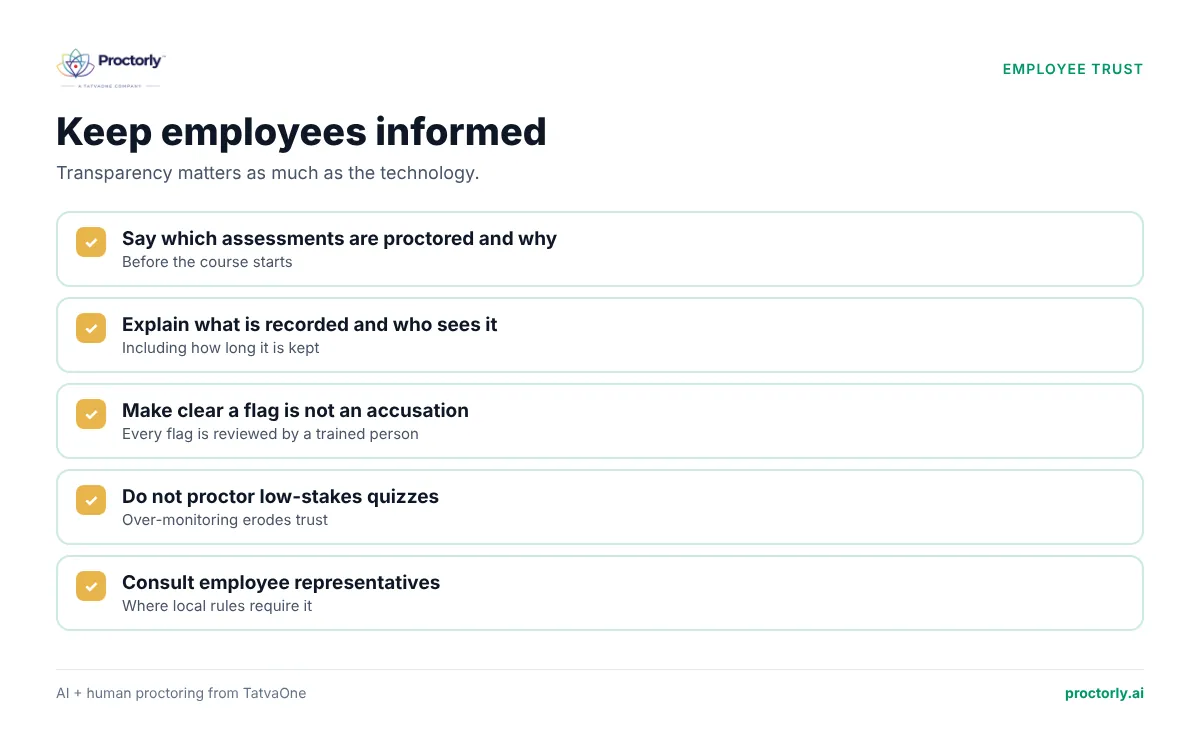
Employees are more wary of monitoring at work than students are in exams. Earn trust early.
- Tell them which assessments are proctored and why, before the course starts.
- Explain what is recorded, who can see it, and how long it is kept.
- Make clear that a flag is not an accusation. In Proctorly, every flag is reviewed by a trained person and no automated flag can fail anyone.
- Do not proctor low-stakes quizzes. Over-monitoring erodes trust fast.
- Consult works councils or employee representatives where required.
Proctorly hosts data in your region, lets you set retention, and does not train AI on your data unless you opt in. Details in the Trust Center.
Regulation to watch
The EU AI Act lists AI systems used to monitor and detect prohibited behaviour during tests in education and vocational training as high-risk (EU AI Act, Annex III). If you train staff in the EU, expect requirements around human oversight, documentation and transparency. A human-in-the-loop design, where AI flags and people decide, is a strong starting point. The ITC and ATP Guidelines for Technology-Based Assessment are also a practical reference for test security and fairness (SIOP summary).
People also ask
Should compliance training tests be proctored? Only where a pass carries regulatory or safety weight. Routine knowledge checks rarely justify it.
Can employees cheat on online training assessments? Yes: sharing answers, having a colleague take the test, or using AI tools. Identity checks and monitoring reduce this.
Is it legal to monitor employees during online tests? Generally yes with notice and a legitimate purpose, but rules vary. Check local employment and data protection law.
FAQs
Can Proctorly work with our LMS or LXP?
Proctorly integrates with Moodle via LTI 1.3 and supports Canvas and Blackboard. It can also deliver exams on its own. Book a meeting to check your platform.
Can we proctor partner and customer certification exams?
Yes. The same controls used by certification bodies apply to partner and customer credentials.
What do employees need to take a proctored test?
A laptop, desktop, tablet or phone with a camera and microphone, a supported browser and a basic internet connection.
Will monitoring slow down certification?
No. Proctorly reviews 95 of every 100 flags within 5 minutes during exam windows.
Turn completions into proof of competence
Proctoring every quiz would waste budget and goodwill. Proctoring the few assessments that carry real risk gives your auditors, regulators and customers evidence they can rely on. Start with one high-stakes certification and build from there.
Make your certifications count. Book a Demo or Book a Meeting.