
Key takeaways
- A proctored pre-employment assessment is a remote hiring test supervised with identity checks, a locked test environment and monitoring, so the score reflects the candidate’s own skill.
- Proxy test-takers, AI assistants and leaked questions are the three biggest threats to remote hiring tests.
- Proctor the stages that drive decisions, not every screening quiz. Light checks early, stronger checks for final technical or role-critical tests.
- A flag should prompt a human look, never an automatic rejection.
- Fairness still depends on a validated test and clear candidate communication.
Remote hiring made assessments cheaper and faster to run. It also made them easier to fake. Recruiters now see candidates who ace an online coding test and then struggle in the interview, or who look different on camera from the person who sat the screening test.
If that sounds familiar, you do not need to go back to test centres. You need to put the right controls on the right stages. This guide explains how.
Hiring at volume and worried about test integrity? Book a meeting to talk through your assessment funnel.
What is a proctored pre-employment assessment?
A proctored pre-employment assessment is an online skills, aptitude or knowledge test that a candidate takes remotely under supervision: their identity is verified, the test runs in a controlled browser, and webcam, screen and device signals are monitored and reviewed so the hiring team can trust that the score belongs to the candidate.
Why remote hiring tests are under pressure
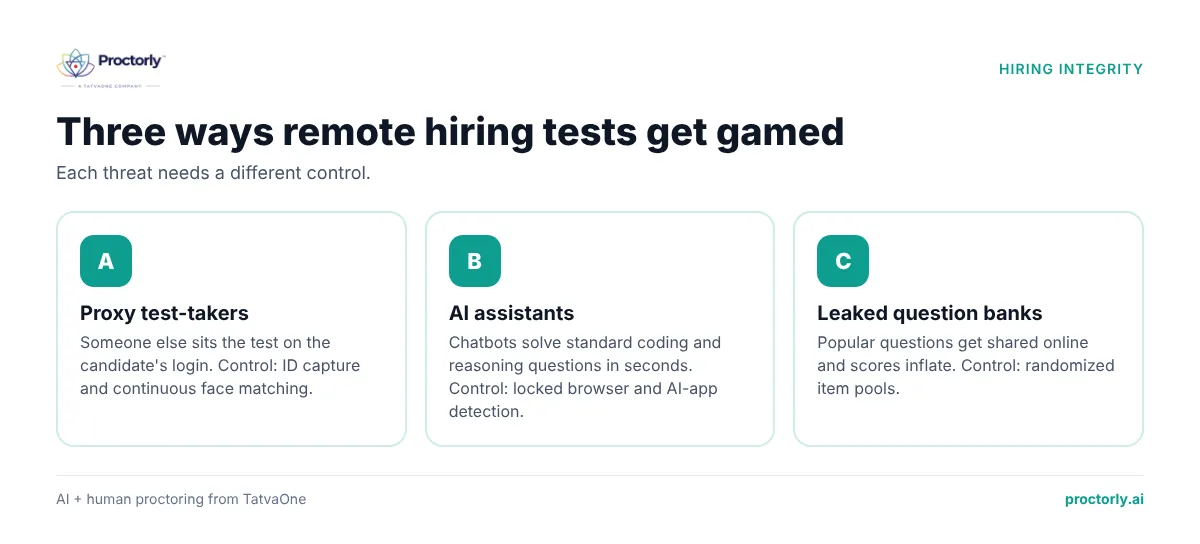
Proxy test-takers
The simplest way to pass a test you cannot pass is to have someone else take it. Without identity checks, a hiring team has no way to tell.
AI assistants and copied answers
Generative-AI tools can solve many standard coding and reasoning questions in seconds. A test that once separated strong and weak candidates can now measure who had a chatbot open in another window.
Shared question banks
Popular employers’ questions get posted online. Once a bank leaks, scores rise and stop predicting performance.
Which hiring stages should you proctor?
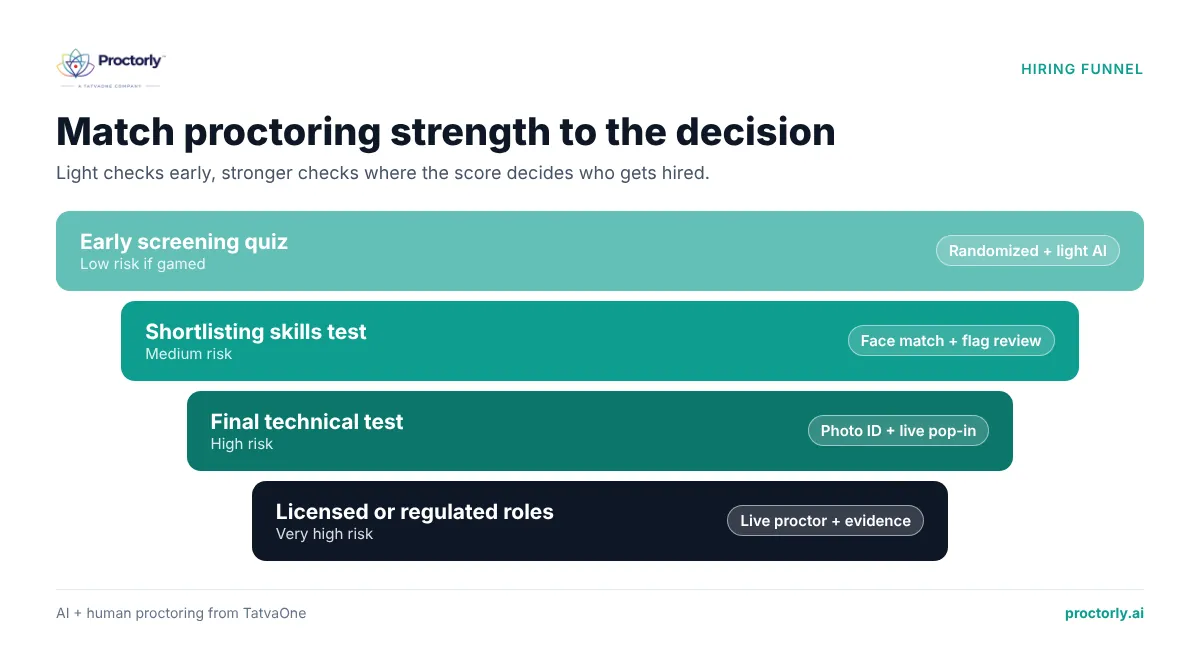
Not every step needs heavy supervision. Over-proctoring a five-minute screening quiz annoys good candidates and adds cost. Match the control to the decision the score drives.
| Hiring stage | Risk if gamed | Suggested control |
|---|---|---|
| Early screening quiz | Low | Randomized questions, time limits, light AI monitoring |
| Aptitude or skills test that shortlists | Medium | Face verification, locked browser, every flag reviewed |
| Final technical or role-critical test | High | Photo ID, continuous face match, live pop-in or live proctor |
| Licensed or regulated roles | Very high | Full identity check with live proctor and evidence record |
How to set up proctored hiring assessments in 5 steps
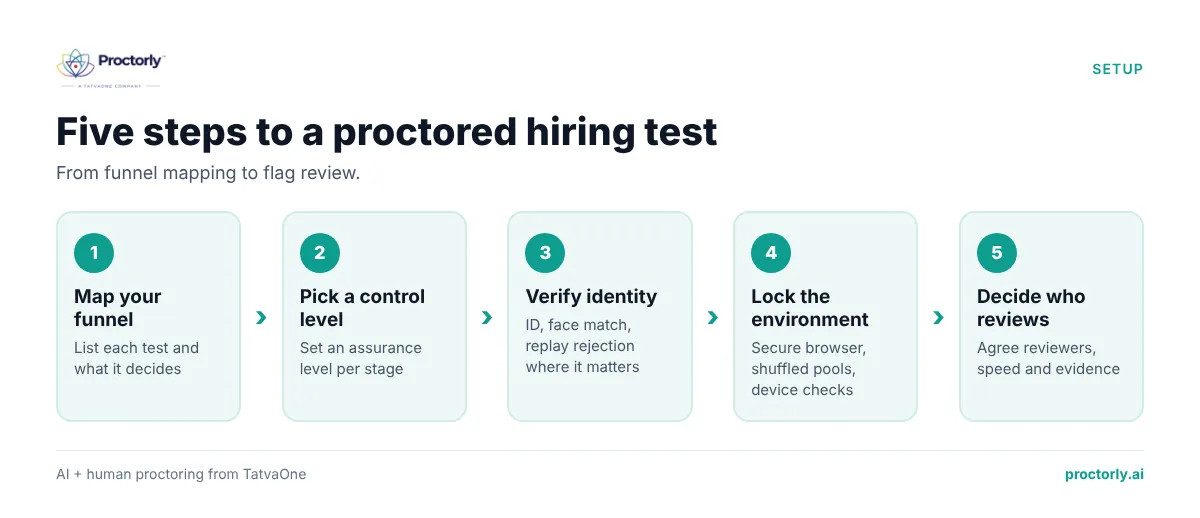
- Map your funnel. List each assessment, what it decides, and its current pass rate.
- Pick a control level per stage. Use the table above. Proctorly sets the assurance level per exam, so one platform can run light and strict tests side by side.
- Verify identity where it matters. Use photo ID capture, face matching and replay rejection for shortlisting and final tests. See how Proctorly identity verification works.
- Lock the environment. Run the test in a secure exam browser, shuffle questions from pools, and detect remote-access tools, extra monitors and known AI apps.
- Decide who reviews flags. Agree whether your recruiters or a trained proctoring team review flags, how fast, and what evidence goes to the hiring manager.
Want to see a hiring test with identity checks and flag review? Book a Proctorly demo.
Keeping it fair: candidate experience and compliance
Validate the test, not just the proctoring
Proctoring protects a score. It does not make a weak test a good one. In the US, the EEOC reminds employers that tests and selection procedures must be job-related and should not screen out protected groups without justification (EEOC). Similar principles apply in most markets. Validate the test first, then secure it.
Accommodations and transparency
Tell candidates in advance what is monitored, why, and how data is used and stored. Offer accommodations and make sure assistive tools are not flagged as misconduct. Proctorly’s reviewers are trained not to treat reading aloud, assistive tools or disability-related movement as cheating, and no automated flag can reject a candidate on its own. Data stays in your region, and candidate data is not used to train AI unless you opt in (Trust Center).
What to measure after launch
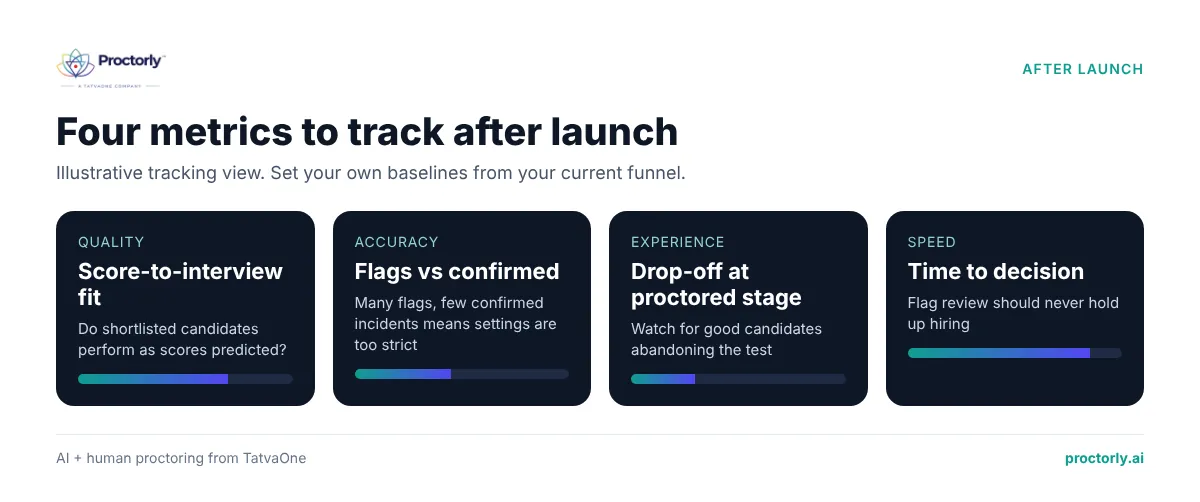
- Score-to-interview consistency: do shortlisted candidates perform as their test scores predicted?
- Flag rate and confirmed-incident rate: a high flag rate with few confirmed incidents means your settings are too strict.
- Drop-off at the proctored stage: if good candidates abandon, simplify the setup or move proctoring to a later stage.
- Time to decision: flags should not slow your hiring timeline.
People also ask
Can candidates cheat on online hiring assessments? Yes, if tests run without identity checks or monitoring. Proxy testing and AI assistants are the most common methods.
Do proctored tests put candidates off? Some candidates dislike monitoring. Clear communication, light controls early in the funnel and fast flag review reduce drop-off.
Is webcam proctoring legal for hiring? Generally yes with notice and consent, but rules vary by country. Check local privacy and employment law.
FAQs
What is the difference between proctored and unproctored hiring tests?
Unproctored tests rely on trust. Proctored tests add identity verification, a controlled environment and monitoring so the hiring team can rely on the score.
Will AI monitoring reject candidates automatically?
It should not. In Proctorly, every flag goes to a trained person who records a decision and reason. A flag is a signal, never a verdict.
Can we proctor tests from our existing assessment platform?
It depends on the platform. Proctorly can deliver tests in its own exam environment and connects to LMS platforms through LTI 1.3. Book a meeting to check your stack.
What do candidates need?
A laptop, desktop, tablet or phone with a camera and microphone, a supported browser and a basic connection (512 Kbps down, 128 Kbps up). Point candidates to the webcam test before the exam.
How quickly are flags reviewed?
Proctorly’s reviewers handle 95 of every 100 flags within 5 minutes during exam windows, so hiring decisions are not held up.
Hire on real skills
Remote assessments only help hiring if the scores are real. Verify identity where the stakes are high, lock down the test environment, keep a person behind every decision and tell candidates what to expect. You get faster hiring and fewer interview surprises.
See it in action. Book a Demo or Book a Meeting to design a proctored hiring funnel.